 Save
Save I'll never forget the first time I created the Star of David salad for my family's Hanukkah celebration. My daughter had just asked if we could make something that looked as beautiful as the holiday itself felt, and suddenly I found myself arranging cucumber slices into geometric patterns on our largest platter. What started as an ambitious idea became a beloved tradition that now appears at every festive gathering, proving that the most memorable dishes are often the ones that feed both the eyes and the heart.
I still remember my neighbor peeking over the fence during a summer gathering, asking if we were really going to eat something that beautiful. By the end of the evening, the star had been picked apart into memories, and she was already planning to make it for her own family dinner. That's when I realized this salad wasn't just about the presentation—it was about creating a moment worth remembering.
Ingredients
- Baby spinach leaves (6 cups): Choose the most tender, delicate leaves you can find; they create a soft, forgiving base that shows off the vibrant vegetables layered on top
- Arugula (3 cups): The peppery bite balances the sweetness of the tomatoes and adds personality to every bite
- Cucumbers (2 large): Slice them thin enough that they hold their shape but tender enough to bite through easily; these become your artistic framework
- Cherry tomatoes (2 cups): Halving them creates little jewel-tones that catch the light and make the star shimmer
- Bell peppers, yellow and red (1 each): Their sweetness and contrasting colors are what make this platter sing visually
- Purple cabbage (1 cup shredded): This is your secret for adding crunch and earthiness that grounds all the brightness
- Red onion (1/4 cup, optional): Slice it paper-thin if you choose to use it; the sharpness wakes up the palate
- Feta cheese (1 cup crumbled): This is where the richness lives—let it sit at room temperature for a few minutes so it crumbles more easily
- Kalamata olives (1/3 cup): Halve them lengthwise and scatter them like dark confetti along the star's points
- Capers (2 tablespoons, optional): Their briny punch adds sophistication and complexity
- Pine nuts (1/4 cup toasted): Toast them yourself in a dry pan just until fragrant; this small step transforms them from ordinary to unforgettable
- Extra virgin olive oil (1/4 cup): This is not the time to skimp—choose one you actually enjoy tasting on its own
- Lemon juice (2 tablespoons): Fresh squeezed makes all the difference; it brightens without overpowering
- Red wine vinegar (1 tablespoon): This adds depth and keeps the dressing from being one-dimensional
- Honey or maple syrup (1 teaspoon): Just enough sweetness to balance the acidity
- Dijon mustard (1 teaspoon): This acts as an emulsifier and adds a subtle complexity that ties everything together
- Kosher salt and freshly ground black pepper: Season generously; underseasons robs the vegetables of their natural brilliance
Tired of Takeout? 🥡
Get 10 meals you can make faster than delivery arrives. Seriously.
One email. No spam. Unsubscribe anytime.
Instructions
- Gather your canvas:
- Choose your largest, flattest serving platter—this is your stage. If it has a slight rim or raised edge, even better, as it keeps everything contained. Take a moment to imagine where your star will live on this surface.
- Create the green foundation:
- Gently spread the baby spinach and arugula across the entire platter in a thin, even layer. Use your hands to guide them, letting some leaves overlap naturally. This cushion of greens is what makes the vegetables pop and keeps everything from sliding around.
- Outline your star:
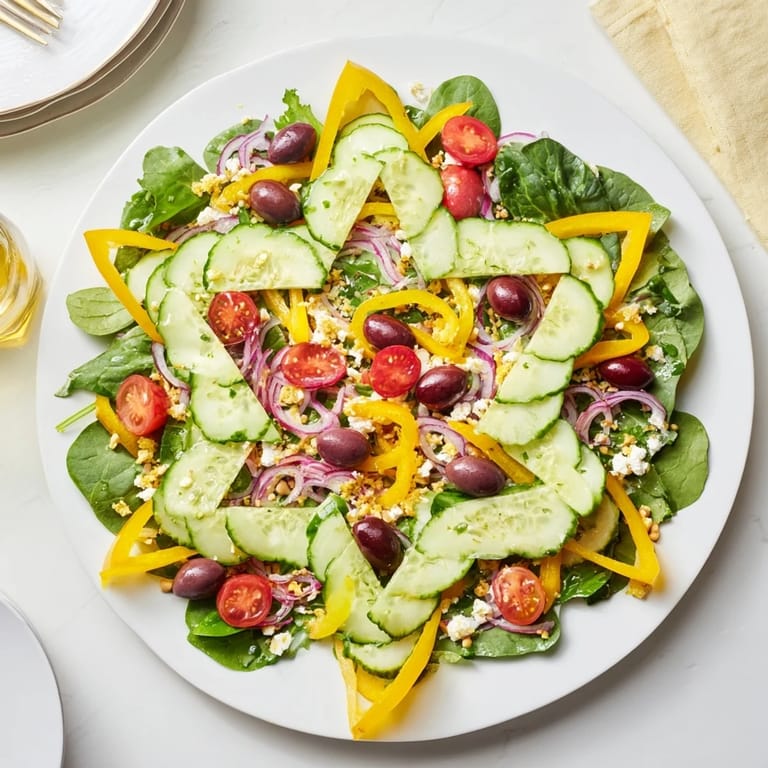
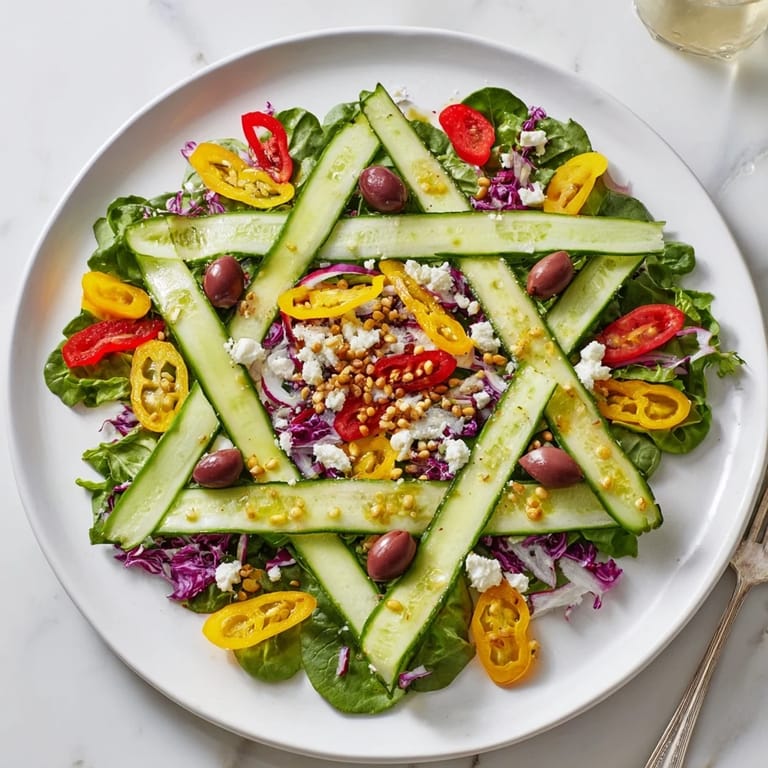
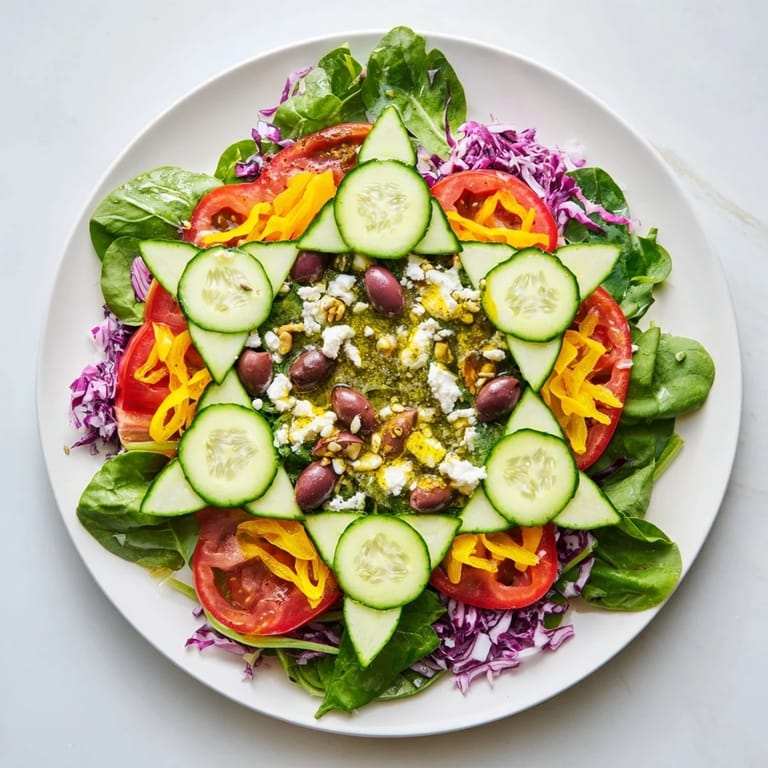
- Here's where the magic happens. Arrange your thin cucumber slices into two overlapping equilateral triangles—one pointing up, one pointing down. Step back frequently to check your angles. If cookie cutters help you visualize the triangles, use them as guides. The cucumbers should create a clear, unbroken outline that frames everything inside.
- Paint with color:
- Fill each of the six triangular sections between your cucumber outline with groups of cherry tomatoes, bell peppers, and purple cabbage. Think like you're painting—each section gets its own dominant color or combination. Let the colors contrast with their neighbors so the geometry stays clear and striking.
- Accent the geometry:
- Scatter crumbled feta cheese, halved olives, capers, and toasted pine nuts around the star's edges and points. Use these finishing touches to define and accentuate the geometric shapes you've created, adding texture and visual complexity.
- Prepare the dressing:
- In a small bowl, whisk together the olive oil, lemon juice, vinegar, honey, and mustard until they come together into a glossy emulsion. Add the salt and pepper, then taste and adjust. The dressing should sing—bright, balanced, with no single flavor shouting over the others.
- Finish and serve:
- Just before serving, drizzle the dressing evenly across the platter in gentle streams, or offer it on the side so guests can dress their portions to taste. Serve immediately while everything is at its crispest and most vibrant.
 Save
Save What touched me most was watching three generations stand around that platter, pointing out which vegetables they'd chosen to arrange, talking about the meaning of the star, and then eating together with their hands, laughing when the cucumber slices bent just a little. Food that brings people into conversation and connection—that's the real victory.
The Art of Presentation
This salad lives at the intersection of nourishment and artistry. The moment you place it on the table, you're sending a message that this meal matters, that you've thought about not just what to serve, but how to honor it. I've learned that the presentation doesn't need to be perfect—a slightly wobbly triangle or an olive that rolls out of place only adds to the authentic, handmade charm. Let the imperfections show that real hands and real care went into creating this moment.
Variations and Customization
The beauty of this salad is that it welcomes your preferences and dietary needs without losing its soul. I've made it with grilled chicken strips tucked into the points for protein, scattered warm chickpeas for earthiness, and even swapped dairy feta for a creamy cashew version for friends avoiding animal products. Each variation felt distinctly its own while staying true to the original vision. The geometric structure gives you a framework to work within, but plenty of room to make it yours.
Serving Suggestions and Pairing
This star shines brightest as part of a festive spread, whether you're celebrating a holiday or creating one of your own. Serve it alongside warm pita bread, crispy matzo, or soft challah—something to give guests options for how they want to enjoy the salad. A light Sauvignon Blanc or a sparkling water with fresh herbs complements the brightness without competing for attention. I've found that positioning the platter as the centerpiece—literally at the center of the table—transforms it from just another salad into a conversation starter and a visual anchor for the whole meal.
- Let guests build their own bites rather than pre-mixing everything together
- Have extra dressing on hand because generous people always pour generously
- If making ahead, keep components separate and assemble no more than an hour before serving
 Save
Save This salad has taught me that the most nourishing meals are often the ones that feed something deeper than hunger. Make it with love, serve it with intention, and watch how a simple arrangement of vegetables becomes a moment people remember.
Recipe Questions & Answers
- → How do I create the star shape on the salad platter?
Use thin cucumber slices to outline two overlapping equilateral triangles on a flat platter, forming the six-pointed star. Adjust angles carefully to keep the shape clear and geometric.
- → Can I substitute the feta cheese for a dairy-free option?
Yes, vegan feta alternatives work well to maintain the texture and flavor while keeping the platter dairy-free.
- → What is the best way to dress the salad?
Whisk olive oil, lemon juice, red wine vinegar, honey, Dijon mustard, salt, and pepper until emulsified, then drizzle evenly over the assembled salad just before serving.
- → Are there suggestions for adding protein?
Consider adding cooked chickpeas or grilled chicken strips (if not vegetarian) within the star to boost protein content.
- → What tools are needed to prepare this salad platter?
A large serving platter, a sharp knife for slicing, a small bowl and whisk for dressing, plus measuring cups and spoons will make preparation easier.